
Muscles Of Human Body
The muscles of the human body work in groups, and knowing where each group sits makes it much easier to plan a balanced workout. The two muscle maps on this page show the main muscles from the front and back. Below them you will find a plain guide to each major group, what it does and which exercises train it best.
You do not need to learn every Latin name. If you know roughly where your chest, back, shoulders, arms, core and legs are, and which movements work them, you can build a routine that leaves nothing out. Each section links to our step-by-step exercise guides so you can go straight from the map to the gym.
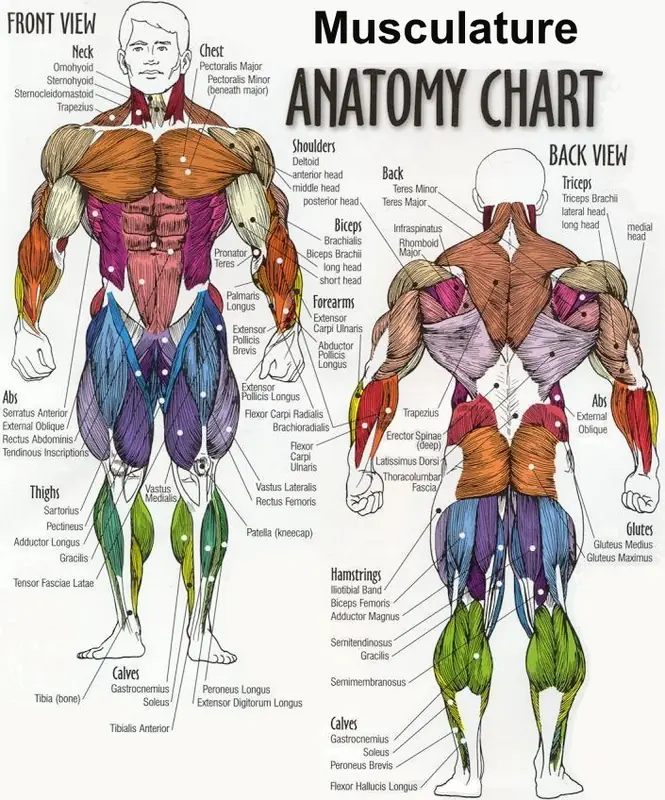
How to use these muscle maps
Download the image above and zoom in to see the muscle you are interested in. The labels are easier to read at full size. Use the map to understand the general structure of the human muscles and to check which area an exercise is meant to target.
A good habit is to look up the muscles for each exercise before you try it. When you know which muscle should be working, you can focus on feeling it during each rep. That mind-to-muscle focus helps you spot when another muscle is taking over because your form has slipped.
Chest and shoulders
Chest
The pectoralis major is the large, fan-shaped muscle across the front of your upper body. It pulls your arms across your chest and pushes weight away from you. Pressing movements train it best, such as the flat barbell bench press, incline and decline presses, dumbbell flyes and push-ups. See all of them in our chest exercises section.
Shoulders
The deltoids cap the top of each shoulder. They have three parts, front, side and rear, and they lift your arm in different directions. Pressing exercises work the front, while lateral raises target the side and rowing movements reach the rear. Underneath sit the small rotator cuff muscles, which keep the joint stable and need careful warming up before heavy lifting.
Which muscles make up your back?
Your back has several large muscle groups that are easy to forget because you cannot see them in the mirror. The latissimus dorsi, or lats, are the wide muscles down the sides of your back that give a V shape. The trapezius runs from your neck across your upper back. The erector spinae are the long muscles running either side of your spine, which keep you upright.
Pulling exercises train the back best. Pull-ups and lat pull-downs build the lats. Seated cable rows thicken the middle of the back. The deadlift and back hyperextensions strengthen the lower back. Our back exercises section covers each one with correct form.
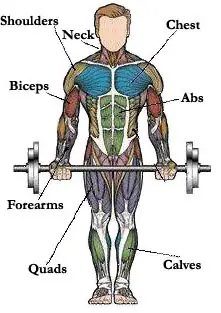
Arm muscles: biceps, triceps and forearms
Biceps
The biceps sit on the front of your upper arm and bend your elbow. Curls are the classic exercise, using a barbell, dumbbells or a cable. Hammer curls, with your thumbs facing up, also work the brachialis underneath and the top of the forearm. Browse our biceps exercises for the full set.
Triceps
The triceps cover the back of your upper arm and make up about two-thirds of its size. They straighten your elbow, so they work hard in every pressing movement. Press-downs, kickbacks, lying extensions and close-grip bench presses all target them directly. Find them in our triceps exercises section.
Forearms
The forearm muscles control your grip and wrist. They get plenty of work from holding bars and dumbbells, so most people do not need to train them separately at first. Later on, dumbbell hammer curls are an easy way to give them extra work.
Core muscles and abs
The rectus abdominis runs down the front of your stomach and creates the six-pack look when body fat is low. The obliques sit at your sides and help you twist and bend sideways. Deeper down, the transverse abdominis wraps around your middle like a belt and steadies your spine.
Exercises such as crunches, leg raises and planks train these muscles directly. Heavy squats and deadlifts also work them hard. Remember that visible abs depend on low body fat as much as strong muscles. Our 6 pack abs section explains both sides.
Which muscles do leg exercises work?
The legs hold the biggest muscles in your body. The quadriceps at the front of the thigh straighten your knee. The hamstrings at the back bend the knee and help extend the hip. The gluteus maximus, the large muscle of your bum, drives you up from a squat and forward when you walk or run. The calves at the back of the lower leg point your foot and push you off the ground.
Squats are the best all-round leg exercise because they train the quads, glutes and hamstrings together. The leg press, lunges and front squats add variety, while leg extensions isolate the quads. Standing or seated calf raises finish the job for the lower legs. All of them are in our leg exercises section.
How should you split training across muscle groups?
Most people do well training each major muscle group once or twice a week. Muscles grow while they rest, so give each group at least 48 hours before working it hard again.
A simple three-day split for beginners looks like this:
- Day 1: chest, shoulders and triceps, which all work together in pushing movements.
- Day 2: back and biceps, which work together in pulling movements.
- Day 3: legs and core.
Why balance between muscle groups matters
It is tempting to train only the "mirror muscles" you can see from the front, such as the chest, biceps and abs. Over time that can pull your shoulders forward into a rounded posture and leave your back and legs weak. Matching every pushing exercise with a pulling one, and never skipping leg day, keeps your body balanced and less prone to injury.
Rest for a day between sessions and finish each one with some abs work if you have time left. Keep this muscle map handy as you plan. When you are ready to choose exercises for each group, our body building section brings every guide together in one place.
Comments (1)
Show / hide
Comments are closed. These comments were preserved from the original site.
#1 Letty Tresler
Excellent blog here! Also your site loads up very fast! What host are you using? Can I get your affiliate link to your host? I wish my web site loaded up as quickly as yours lol