
Daily Calorie Intake Calculator
Your daily calorie intake is the amount of energy you need from food and drink each day to stay fit and healthy at your current weight. As a rough guide, UK reference figures are about 2,000 calories a day for women and 2,500 for men. Your own number depends on your size, age, sex and how active you are, so it can be quite a bit higher or lower.
Our daily calorie intake calculator below works out a personal figure in seconds. Fill in the fields and press Calculate. Then read on to choose the right activity level, compare your result with the chart and set a target for your goal.
How to use the daily calorie intake calculator
The calculator asks for five details: your gender, age, height, weight and activity level. Enter your current weight rather than your goal weight, and your height without shoes. If your scales show pounds or stones, our pounds to kilograms calculator will convert them.
Once every field is filled in, press Calculate. The large figure is the number of calories you need each day to keep your weight steady. A small table under it gives daily targets for mild weight loss, steady weight loss and weight gain.
Choosing the right activity level
This is the setting that changes your answer most, so take a moment over it. The five options are:
- Sedentary: a desk job and little or no exercise.
- Lightly active: light exercise or sport one to three days a week.
- Moderately active: moderate exercise three to five days a week.
- Very active: hard exercise six or seven days a week.
- Extra active: a physical job plus hard training, or training twice a day.
Most people overestimate how active they are. If you are torn between two levels, choose the lower one. A 45-minute gym session three times a week, with a desk job the rest of the time, usually fits "lightly active" or "moderately active" at most.
How the calculator works out your calories
First, the calculator estimates your basal metabolic rate (BMR) using the Mifflin–St Jeor equation. This is the energy your body burns at rest just to keep running. It uses your weight, height, age and sex to work it out.
It then multiplies your BMR by an activity factor. These are 1.2 for sedentary, 1.375 for lightly active, 1.55 for moderately active, 1.725 for very active and 1.9 for extra active. For example, a woman with a BMR of 1,345 calories who is moderately active needs about 2,085 calories a day.
If you want to see your resting figure on its own, or the full formula, try our daily energy expenditure calculator.
Comparing your result with the chart
The chart below shows estimated daily calorie needs by gender, age group and three activity levels. It comes from the 2005 US Dietary Guidelines and gives a useful sense check for your own result.
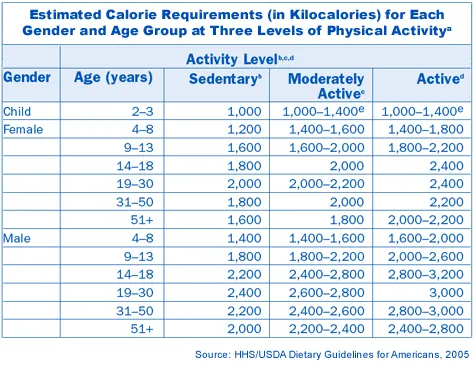
For instance, the chart suggests a sedentary woman aged 19 to 30 needs about 2,000 calories, rising to 2,400 if she is active. A sedentary man of the same age needs about 2,400, rising to 3,000 if active. Needs fall gently with age, so a sedentary man over 51 needs about 2,000.
The chart uses broad age bands and average body sizes. The calculator takes your actual height and weight into account, so its answer is usually the better guide. If the two are far apart, double-check the figures you entered.
How many calories should you eat to lose or gain weight?
The calculator gives your maintenance figure. To change your weight, you adjust from there.
To lose weight
Eat around 500 calories a day below your result. For most people, that leads to a loss of about 0.5 kg (1 lb) a week. A steady loss of 0.5 to 1 kg (1 to 2 lb) a week is a safe, realistic pace. As a rule, women should not go below about 1,200 calories a day and men below about 1,500 without medical advice. Our guide on how to lose weight safely has more tips.
To stay the same
Eat close to your result most days. Your weight will move up and down by a kilogram or so from day to day, mostly because of water and food in your gut. Look at the weekly average instead.
To gain weight
Eat around 300 to 500 calories a day above your result and combine it with strength training. The weight gain row in the calculator's table shows the upper end of that range. This helps more of the extra weight go on as muscle rather than fat. The guide to gaining weight includes a full sample day of meals.
Making your calories count
Two diets with the same number of calories can affect your health, hunger and energy very differently. The quality of what you eat matters as much as the total.
- Include a source of protein at each meal, such as eggs, fish, chicken, beans or yoghurt. It keeps you full for longer.
- Fill half your plate with vegetables or salad for fibre, vitamins and bulk.
- Choose wholegrain bread, rice and pasta over white versions.
- Watch drinks. Fizzy drinks, juice, alcohol and large coffees can add hundreds of calories without filling you up.
- Spread your intake across the day in a way that suits your routine. Three meals work for some people, and smaller, more frequent ones suit others.
Why your result is only a starting point
Any calorie calculator gives an estimate based on averages. Your real needs may be a little higher or lower, depending on things like how much muscle you carry and how much you move outside the gym.
So use your result as a first guess and test it. Eat roughly that amount for two or three weeks and weigh yourself a few times a week. If your weight is steady, the figure is right. If it is drifting, adjust by 100 to 200 calories and check again.
The standard figures are not suitable for children, or for women who are pregnant or breastfeeding. If you have a medical condition such as diabetes, speak to your GP or a dietitian before making big changes. For everyone else, recalculate whenever your weight or activity changes. Check where you stand overall with our BMI calculator.
More in Calculators
Daily Energy Expenditure Calculator
Your daily energy expenditure is the number of calories your body uses in a day. A large part of it goes simply on keeping you alive: breathing, pumping blood, repairing cells and…
Read morePounds to Kilograms Calculator
To convert pounds to kilograms, multiply the number of pounds by 0.4536. One pound is exactly 0.45359237 kg, so 10 lb is about 4.54 kg and 100 lb is about 45.36 kg.…
Read more
Body Fat Calculator
Your body fat percentage is the share of your total weight that is fat rather than muscle, bone, organs and water. It tells you far more about your health and fitness than…
Read more