
Daily Energy Expenditure Calculator
Your daily energy expenditure is the number of calories your body uses in a day. A large part of it goes simply on keeping you alive: breathing, pumping blood, repairing cells and keeping you warm. Once you know this figure, you can plan your meals around losing, gaining or holding your weight.
Our daily energy expenditure calculator below uses the Mifflin–St Jeor equation, one of the most widely used formulas for adults. It gives your resting burn as one large figure, then your daily total at five activity levels. It only needs four details and takes seconds. Below the calculator, we explain what the number means, how it is worked out and how to use it.
How to use the daily energy expenditure calculator
First pick metric or imperial units. Then follow two steps:
- Enter your height, weight, age and gender.
- Press the Calculate button to see your daily energy expenditure.
Use your current weight, not a goal weight, and measure your height without shoes. If you only know your weight in pounds, our pounds to kilograms calculator will convert it for you. Enter your age in whole years.
What does your result mean?
The large figure at the top is an estimate of the calories your body burns over 24 hours at rest. This baseline is often called your basal metabolic rate, or BMR. It is roughly what you would burn if you stayed in bed all day. Below it, a table shows your estimated daily total at each activity level.
That might sound like a small number, but for most people it is the largest part of their daily energy use. Your organs, brain and muscles all need fuel around the clock, even while you sleep.
Where your daily calories go
Your total daily energy use has three main parts:
- Resting energy (BMR): usually around 60% to 70% of the total for people who are not very active.
- Digesting food: breaking down and storing what you eat uses roughly 10% of your daily calories.
- Movement: planned exercise plus everyday activity such as walking, standing, housework and fidgeting.
Movement is the part that varies most from person to person. A desk worker and a builder of the same size can have very different daily totals, even with the same BMR.
Can you raise your daily burn?
You cannot change your age or height, but you can nudge your energy use upwards. Strength training builds muscle, which uses a little more energy at rest than fat. Moving more through the day, such as walking to the shops or taking the stairs, often burns more than a single gym session. Protein also takes slightly more energy to digest than carbohydrate or fat, so including some at each meal helps a little.
The Mifflin–St Jeor equation explained
The calculator uses your weight in kilograms, height in centimetres and age in years. The formulas are:
- Men: (10 × weight) + (6.25 × height) − (5 × age) + 5
- Women: (10 × weight) + (6.25 × height) − (5 × age) − 161
Weight and height push the number up, as a bigger body needs more energy. Age pulls it down, because metabolism slows gradually as we get older, partly through the loss of muscle.
Two worked examples
Take a 35-year-old woman who is 165 cm (5 ft 5 in) tall and weighs 65 kg (10 st 3 lb). Her sum is 650 plus 1,031 minus 175 minus 161. That gives about 1,345 calories a day at rest.
Now take a 35-year-old man who is 178 cm (5 ft 10 in) tall and weighs 80 kg (12 st 8 lb). His sum is 800 plus 1,113 minus 175 plus 5. That comes to roughly 1,743 calories a day at rest.
How accurate is the estimate?
Mifflin–St Jeor is generally seen as one of the more reliable formulas for healthy adults. Even so, it predicts an average person of your size, age and sex. Your real figure can be a few hundred calories higher or lower. If you train with weights, our body fat calculator shows how much of your weight is lean mass, which can explain a higher burn.
Several things can throw it off:
- Muscle: muscle burns more energy than fat, so very muscular people may burn more than the formula suggests.
- Body fat: people with a lot of body fat may burn a little less than predicted.
- Health: thyroid problems, illness and some medicines can raise or lower your metabolism.
- Life stage: the formula is not meant for children or for women who are pregnant or breastfeeding.
The only way to know your true figure is to test it against real life. If you eat a steady amount for two or three weeks and your weight stays the same, that intake is your real maintenance level.
Turning your result into a daily calorie target
Your BMR is only your resting burn, so your full daily needs depend on how active you are. The calculator works this out for you in the table under your result, by multiplying your BMR by these activity factors:
| Activity level | Multiply BMR by |
|---|---|
| Sedentary: little or no exercise | 1.2 |
| Lightly active: exercise 1–3 days a week | 1.375 |
| Moderately active: exercise 3–5 days a week | 1.55 |
| Very active: hard exercise 6–7 days a week | 1.725 |
| Extra active: physical job plus training | 1.9 |
Using the woman in our example, 1,345 × 1.55 gives about 2,085 calories a day if she exercises three to five times a week. Our daily calorie intake calculator does this step for you, using the same formula with an activity level built in.
If you want to lose weight
Aim to eat around 500 calories a day below your full daily needs. For most people, that leads to a loss of about 0.5 kg (1 lb) a week. Avoid eating below your resting figure for long periods, as very low intakes make it hard to get enough nutrients and are tough to stick to. Our guide on how to lose weight at a safe pace has practical tips.
If you want to gain weight
Eat around 300 to 500 calories a day above your full daily needs, and add regular strength training. This helps more of the extra weight go on as muscle. The weight gain diet plan shows what a day of eating could look like.
Recalculate whenever your weight changes by a few kilograms, as your energy needs shift with it. For a fuller view of your health, check your result alongside our BMI calculator and the rest of our free fitness calculators.
More in Calculators
Pounds to Kilograms Calculator
To convert pounds to kilograms, multiply the number of pounds by 0.4536. One pound is exactly 0.45359237 kg, so 10 lb is about 4.54 kg and 100 lb is about 45.36 kg.…
Read more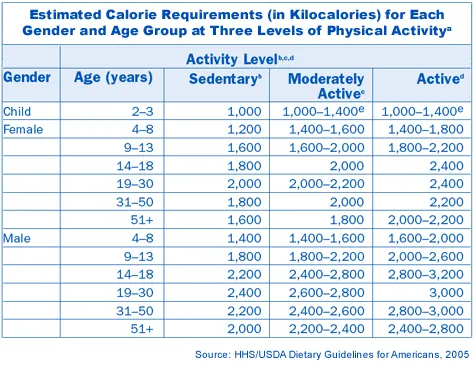
Daily Calorie Intake Calculator
Your daily calorie intake is the amount of energy you need from food and drink each day to stay fit and healthy at your current weight. As a rough guide, UK reference…
Read more
Body Fat Calculator
Your body fat percentage is the share of your total weight that is fat rather than muscle, bone, organs and water. It tells you far more about your health and fitness than…
Read more