
Lateral Pull Downs
The lateral pull down, usually shortened to lat pull down, is one of the best back exercises for building width across your upper body. You sit at a cable machine, take hold of a long bar above your head and pull it down to your upper chest. Because you choose the weight, it suits beginners who cannot yet do a pull-up as well as experienced lifters.
We rate the lat pull down 8.5 out of 10. It is an excellent exercise, but only when you do it properly. This guide covers the muscles it works, how to set up and pull with good form, which grips to try and how many sets to do.
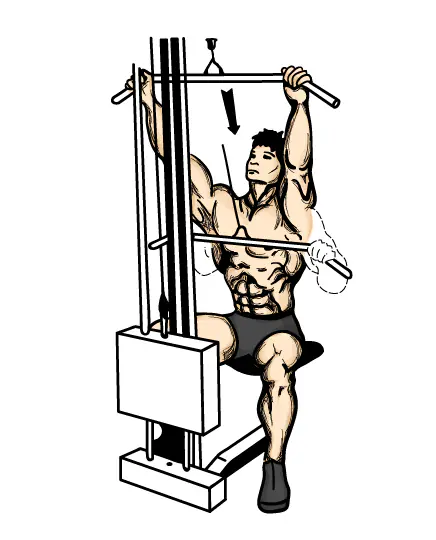
What does the lat pull down work?
The pulldown works your lats, rear deltoids, biceps and forearms, but it puts most of the pressure on the lats and upper back. The lats (latissimus dorsi) are the broad muscles that run from your upper arm down to your lower back. When they grow, your back looks wider and your waist looks narrower by comparison, giving the "V" shape many people train for.
The rear deltoids at the back of your shoulders help draw your arms down and back. Your biceps bend your elbows, and your forearms keep a firm grip on the bar. With all of these working together, the pulldown counts as a compound movement rather than an isolation exercise.
Strong lats also help keep your shoulders stable when you press weights overhead or bench press. They help hold your upper body upright too, which makes a difference if you spend long hours sitting at a desk.
Lat pull down form, step by step
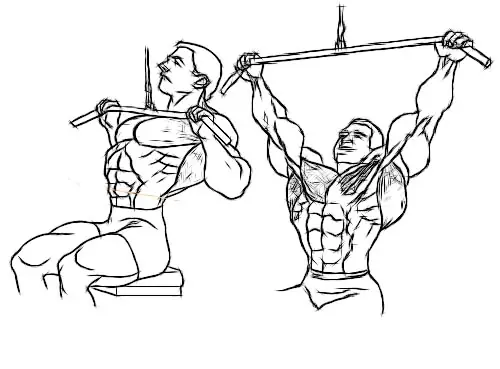
Setting up the machine
- Attach a long bar to the high pulley.
- Adjust the seat so your feet rest flat on the floor and your knees lock firmly under the thigh pads. The pads stop your body lifting off the seat as you pull.
- Choose a moderate weight. You should be able to pull it smoothly without throwing your body back.
The pull
- Grab the bar with your hands a little wider than shoulder width. Wrap your hands fully round the bar.
- Pull the bar down with your lats, leaning back slightly as you bring it towards your chest. Breathe out as you pull it down.
- Hold the bottom position for a second to make the most of the peak contraction.
- Breathe in as you let the bar rise back to the top.
- Straighten your arms fully at the top, back in the starting position, before you begin the next rep.
One helpful cue is to pull your elbows down towards your back pockets, which keeps the work in your back rather than your arms. Keep your chest lifted towards the bar throughout.
Why does form matter more than the weight?
Many people ignore the proper technique and focus only on how much they can pull. That habit can be dangerous. It can cause lower back injuries and unwanted strain on muscles that should not be taking the load.
Watch out for these common errors:
- Leaning too far back. A slight lean is fine. Lying back turns the pulldown into a rowing movement and stresses your lower back.
- Using momentum. Jerking the bar down with your bodyweight means your lats barely work.
- Pulling behind the neck. This forces your shoulders into an awkward position. Always bring the bar to the front of your chest.
- Letting the bar fly up. Control the bar on the way up as well as on the way down.
Pulldown technique on video
This video shows the correct form from start to finish. Watch it before your next back workout, then try a light warm-up set while you copy the movement.
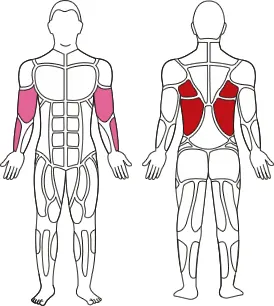
The diagram above shades the lats in dark red and the biceps in pink. Your rear deltoids and forearms help as well. Our muscle map shows each of these muscles and where it sits in your body.
Which grips should you try?
For variety, change your hand grip to work your back from different angles. Wide, narrow, overhand and underhand grips each shift the effort slightly.
Wide overhand grip
This is the standard version described above. Your palms face away from you and your hands sit a little wider than your shoulders. It places the most emphasis on the outer lats and the width of your back.
Narrow or close grip
A close grip, often with a V-handle, lets your elbows travel close to your body. Many people find they can pull more weight this way, and it brings in the lower lats and middle back.
Underhand grip
With your palms facing you and hands about shoulder width apart, your biceps join in more. It feels similar to a chin-up, so it is good practice if you are working towards one.
You do not need to use every grip in one workout. Pick one main grip for a few weeks, then swap to another. Some people like to do their first sets with a wide grip and finish with a close grip once the lats are already tired. Whichever you choose, the setup and the slow, controlled pull stay the same.
Sets, reps and moving on to pull-ups
A good starting point is 3 sets of 10–12 reps with a weight that leaves you one or two reps short of failure. Rest for about 90 seconds between sets. When you can complete every set with clean form, increase the weight slightly.
Start with one lighter warm-up set of about 15 reps. It gets blood into your back and shoulders and lets you rehearse the movement before the working sets. Training your back once or twice a week, with a rest day or two in between, is enough for steady progress.
The pulldown makes an ideal stepping stone to pull-ups and chin-ups. As the weight you can pull approaches your own bodyweight, start trying assisted pull-ups as well. For a complete back session, follow your pulldowns with seated cable rows to build thickness through the middle of your back. You will find more options in our best back exercises section.
More in Back Exercises
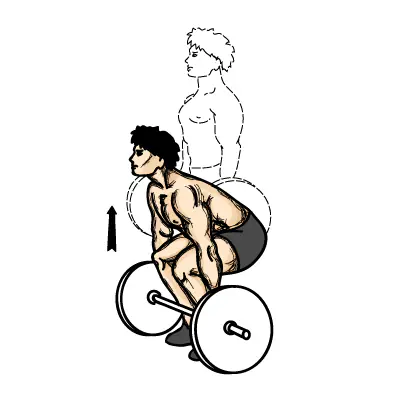
Deadlift
The deadlift is one of the best compound exercises you can do. In a single movement you lift a loaded barbell from the floor to standing, using your legs, hips, back and…
Read more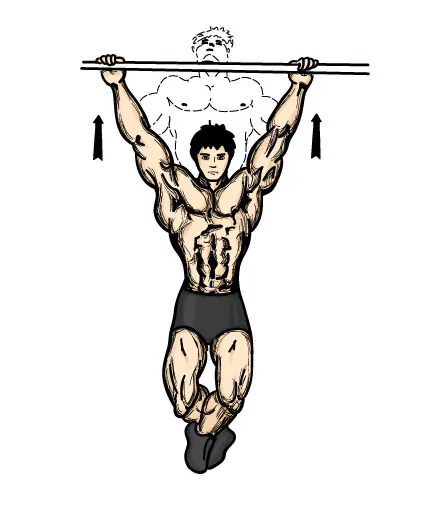
Pull Ups for Back
Pull-ups are among the oldest strength exercises there are, and they are still widely seen as the king of back exercises. You hang from a bar and pull your own bodyweight up…
Read more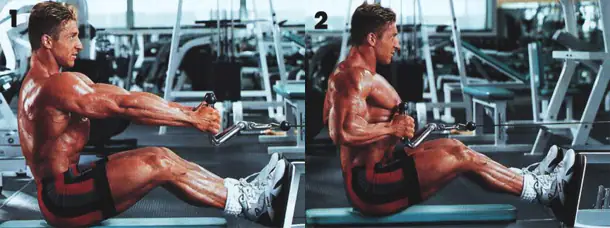
Seated Cable Rows
Seated cable rows are one of the most reliable ways to build a thicker, stronger back. You sit at a low cable station, pull a V-bar handle towards your stomach and let…
Read moreComments (2)
Show / hide
Comments are closed. These comments were preserved from the original site.
#1 Domingas
that’s really nice research.
#2 Cassiana
i am glad to read this post, its an interesting one. i am always searching for quality posts and articles and this is what i found here thanks,