
Back Hyperextension
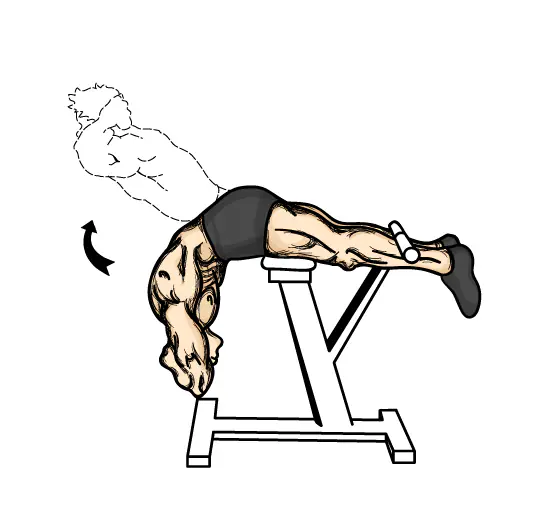
The back hyperextension is a lower back exercise performed on a hyperextension bench, sometimes called a Roman chair. You lock your legs against the pads, lower your upper body towards the floor and then raise it back up in line with your legs. It builds strength in your lower back, buttocks and hamstrings, and it helps you hold a better posture.
We rate the hyperextension 8 out of 10, which makes it one of the most effective lower back exercises you can add to a back workout. Form matters a great deal. Done badly, it can bring on back pain and other back problems, so this guide focuses on doing it slowly and correctly.
Why train your lower back on its own?
Your lower back works in almost every big lift. It keeps your spine steady in squats and deadlifts, and it holds you upright when you row. Yet it rarely gets direct training, and a weak lower back is often the first thing to tire.
The hyperextension trains it through a controlled, bodyweight movement. Because you can start with no added load, it suits building endurance in the muscles along your spine. Many people who sit at a desk all day also find that stronger glutes and lower back muscles make standing tall feel easier.
If you have a current back injury or ongoing pain, check with your GP or a physiotherapist before you start. Movement often helps the back, but the right exercise depends on the cause.
Setting up the bench
Most hyperextension benches are either flat or set at 45 degrees. Both work the same muscles. Beginners usually find the 45-degree version easier, because the top of the movement is less demanding.
Adjust the hip pad so its top edge sits just below the crease of your hips. If the pad is too high, it blocks your hips from bending and you will feel the movement in your spine instead. Set it too low and you may slide off. Hook your ankles under the foot pads so your legs feel secure.
Lower back hyperextension form, step by step
Lowering down
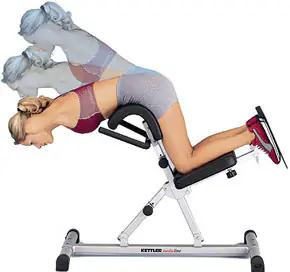
- Place your thighs firmly against the pads of the hyperextension machine.
- Cross your hands over your chest and start with your body in a straight line.
- Lower your upper body by bending at the waist until it is perpendicular to the floor. Breathe in as you go down.
Coming back up
- Squeeze your glutes and raise your upper body smoothly, breathing out as you rise.
- Stop when your whole body is aligned in a straight line. That is the highest point of the movement.
- Pause for a moment, then lower again under control. Never jerk your back as you change direction.
Aim for about two seconds down and two seconds up. Moving this slowly keeps the tension on your muscles rather than on your joints, and it makes swinging much harder.
See the hyperextension exercise in action
The video below shows the full range of the movement. Notice the steady pace on the way up and down, and use it to check how high you should rise.
How high should you come up?
You should never rise above a straight body position. Picture a long board laid along your back, parallel to your legs. At the top of each rep, your body should line up with that board, with no bend backwards.
Many people swing up as high as they can, arching the lower back like a banana. That squeezes the joints at the back of the spine and is a common reason the exercise causes pain. A straight line gives the muscles all the work they need without that strain. Poor form causes similar trouble on other machines too, as our guide to injury-prone gym exercises explains.
Other mistakes to avoid include:
- bouncing out of the bottom position to build momentum;
- dropping quickly instead of lowering under control;
- pulling on your neck by looking up sharply at the top;
- holding your breath instead of breathing out on the way up.
Which muscles do hyperextensions work?
The muscles worked in a hyperextension are the spinal erectors, buttocks and hamstrings. The spinal erectors are two long columns of muscle on either side of your spine, and they straighten your back and keep it stable. Your glutes and hamstrings extend your hips. Together they do much of the lifting.
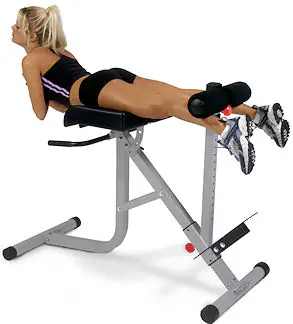
See our muscle map for the position of each of these muscles in your body.
Sets, reps and progression
Do 4 sets of 10–12 repetitions, resting for about a minute between sets. If you are new to the exercise, it is fine to start with 2 sets and build up to 4 over a few weeks.
Adding resistance
When bodyweight reps feel easy, you can add resistance by holding a weight plate to your chest. Start with a light plate and keep your arms crossed over it. The rules on form stay exactly the same. If the extra load makes you swing or arch, go back to a lighter plate.
An easier starting point
If you do not have a bench, or the full movement feels too hard, try floor back extensions. Lie face down with your arms by your sides and gently lift your chest a few centimetres, then lower it. This builds the same muscles at a lower intensity.
Once you can do 3 sets of 15 slow floor extensions with no discomfort, you are usually ready to move on to the bench. Begin there with bodyweight only and a shorter range, then work down to the full movement.
Where it fits in your week
Hyperextensions work best as a finisher. Do them at the end of your back workout, after heavier lifts such as the deadlift or seated cable rows. That way your lower back is still fresh for the big lifts.
Once or twice a week is enough for most people. Your lower back muscles also work hard in squats and deadlifts, so count those sessions when you plan your week. If your back feels stiff or sore the next day, cut back to fewer sets until it settles.
More in Back Exercises
Deadlift
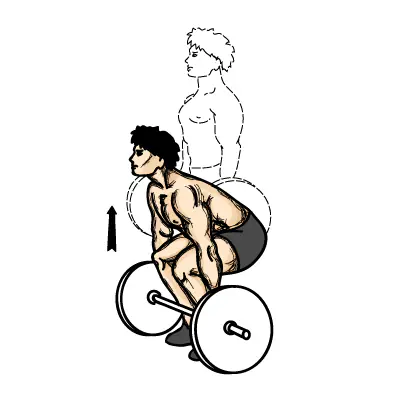
The deadlift is one of the best compound exercises you can do. In a single movement you lift a loaded barbell from the floor to standing, using your legs, hips, back and…
Read more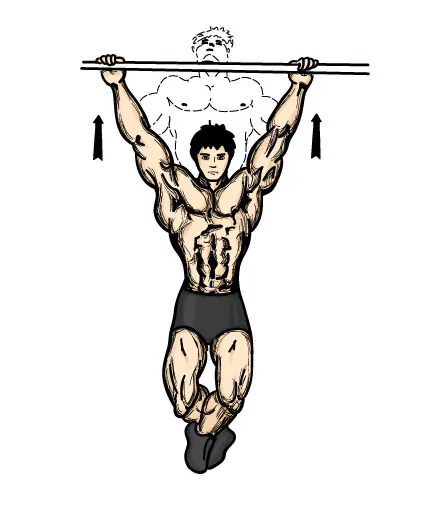
Pull Ups for Back
Pull-ups are among the oldest strength exercises there are, and they are still widely seen as the king of back exercises. You hang from a bar and pull your own bodyweight up…
Read more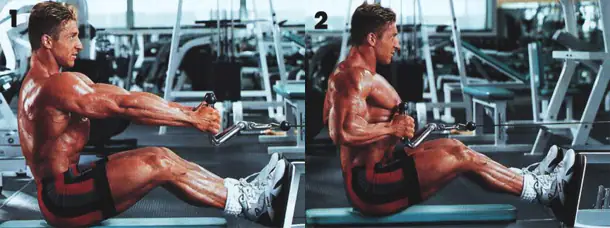
Seated Cable Rows
Seated cable rows are one of the most reliable ways to build a thicker, stronger back. You sit at a low cable station, pull a V-bar handle towards your stomach and let…
Read moreComments (1)
Show / hide
Comments are closed. These comments were preserved from the original site.
#1 Tom Pettaway
God of back exercises