
Standing Dumbbell Curls
Standing dumbbell curls are a simple, effective biceps exercise that you can do almost anywhere. You stand with a dumbbell in each hand, keep your elbows by your sides and curl the weights up to your shoulders. It is a basic movement that works your biceps first and your forearms second, much like the barbell version.
We rate dumbbell curls 9.2 out of 10, and they make an excellent first exercise in a biceps workout. All you need is a pair of dumbbells, so they suit home training as well as the gym. This guide covers correct form, the muscles involved, how to choose your weight and some useful variations.
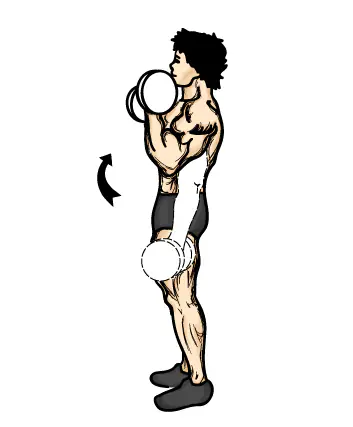
How are dumbbell curls different from barbell curls?
Both exercises train the same muscles, and you can read about the bar version on our standing barbell curls page. The big difference is that each arm holds its own weight.
That has practical benefits. A stronger arm cannot quietly help a weaker one, so any imbalance between your sides shows up and is easier to fix. Your wrists are also free to turn as you curl, which many people find more comfortable on the elbows. The dumbbells can also travel in a natural path rather than being fixed to one straight bar, so each arm finds its own line.
You will usually lift a little less in total than with a barbell. That is fine, because control matters far more than the number on the dumbbell.
Dumbbell curl form, step by step
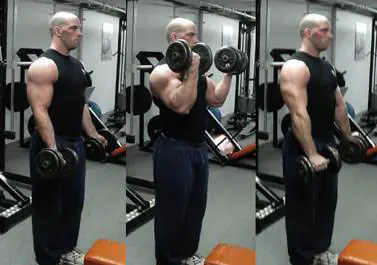
Starting position
- Pick up a pair of dumbbells and stand straight, with your feet shoulder width apart.
- Let the dumbbells hang at arm's length on either side of your body.
- Fix your elbows close to your torso. Keep them there the whole time you are curling.
The curl
- Moving only your forearms, use your biceps strength to curl the dumbbells up until they reach shoulder level. Breathe out as you lift.
- As you curl, turn your wrists into a comfortable position, as shown in the first picture. Most people start with palms facing their thighs and finish with palms facing up.
- At the top you should feel strong pressure in your biceps. Pause there for a moment.
Lowering
- Slowly lower the dumbbells back to the starting position, breathing in as you go.
- Straighten your arms fully at the bottom before the next rep.
- Repeat all the steps. Do 3–4 sets with 10–12 reps each.
Dumbbell curls on video
The video below takes you through the whole movement. Watch how the elbows stay pinned and how slowly the weights come back down, then copy that pace in your own sets.
Which muscles do dumbbell curls work?
The main target is the biceps brachii at the front of your upper arm. Besides bending your elbow, it also turns your palm upwards, so twisting your wrist as you curl adds to the squeeze at the top.
The brachialis, a flat muscle beneath the biceps, helps bend the elbow on every rep. Your forearm muscles work as secondary movers and keep a firm grip on each dumbbell. Your core helps you stand tall and still.
Muscles grow during the recovery that follows a workout. Eating enough protein across the day and sleeping well both help your biceps respond to the training. Working the same muscles hard every day leaves them little time to rebuild, so give your arms at least a day off between sessions.
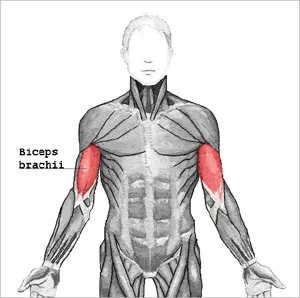
Take a look at our muscle map for details of these muscles and where they sit in your body.
How heavy should your dumbbells be?
Choose a weight that lets you finish every rep with strict form, while the last two reps of each set still feel hard. For many beginners that means light dumbbells for the first few weeks. Increase the weight only when you can complete all your sets at 12 reps.
Dumbbells usually go up in steps of 1 to 2.5 kg (about 2 to 5 lb). Even a small jump can feel big for the biceps, which are fairly small muscles. If the heavier pair makes your form slip, stay with the lighter pair and add a rep or two each week instead.
Do not try to lift too much and swing the dumbbells up with momentum. Use a lighter weight and keep the arm movement slow and controlled. Swinging shifts the effort onto your back and shoulders, and your biceps miss out.
Other points to watch:
- Keep your body still. Your torso should not lean back as the weights rise.
- Keep your elbows back. If they drift forward, your shoulders start lifting the weight.
- Use the full range. Straighten your arms at the bottom and curl all the way up.
- Control the lowering. Take about two seconds to bring the dumbbells down.
Variations and a simple home routine
One arm at a time
For variety, you can do this exercise with one arm at a time. Curling a single dumbbell lets you focus fully on one biceps, and you can rest the other hand on your hip or a support. Alternating curls, where your arms take turns, are another option. Each arm gets a brief rest between reps, so many people can handle slightly heavier weights.
Seated dumbbell curls
Sitting on a bench with your back supported makes it much harder to swing. Try it if you find yourself rocking during standing sets.
Incline dumbbell curls
Lie back on a bench set to about 45 degrees and let your arms hang straight down. Your biceps start each rep from a longer, stretched position, which makes the exercise feel harder. Use lighter dumbbells than usual and keep your shoulders against the bench.
At home, a pair of adjustable dumbbells is all you need for a solid arm session. Start with standing dumbbell curls, then move on to hammer curls for the forearms. Finish with concentration curls for a strong peak contraction. Do this once or twice a week and keep adding a little weight as your form allows. Browse our biceps exercises for more ideas.
More in Biceps Exercises
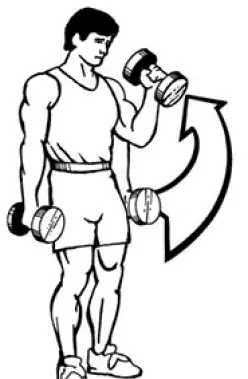
Dumbbell Hammer Curls
Dumbbell hammer curls are a basic curl in which you hold the dumbbells with your palms facing each other, like gripping a hammer. That simple change of grip spreads the work between…
Read more
Concentration Curls
Dumbbell concentration curls are an isolation exercise for the biceps. You sit on the end of a bench, brace one arm against your inner thigh and curl a single dumbbell up towards…
Read more
Standing Barbell Curls
Standing barbell curls are one of the most effective exercises for building bigger, better-shaped biceps. You hold a barbell with an underhand grip, keep your elbows still at your sides and curl…
Read moreComments (16)
Show / hide
Comments are closed. These comments were preserved from the original site.
#1 Walkin Dusche
Hey there! Do you use Twitter? I’d like to follow you if that would be okay. I’m undoubtedly enjoying your blog and look forward to new posts.
#2 Walkin Dusche
Thank you, I’ve just been searching for information about this topic for ages and yours is the best I have discovered till now.
#3 Vender Ouro
Dumbbell curls help biceps grow. Its such as you read my mind! You seem to know a lot approximately this, like you wrote the ebook in it or something. I think that you simply can do with some percent to power the message home a bit, but other than that, this is wonderful blog. An excellent read. I’ll definitely be back.
#4 MuayThai
Your site is simply beautiful.
#5 Retha Eicke
yes, its the best exercise
#6 seema
my skinny arms are in shape by this exercise…
#7 Sam
you have a great blog here! would you like to make some invite posts on my blog?
#8 Carmine Castelo
Bicpes is all..
#9 India Gurule
Hey There. I found your blog using msn. This is a very well written article.
#10 Izzykonto
Great design! How did you get that layout?
#11 farah may
It is true that it is excellent.
#12 Sebrina Matsuhara
Excellent for biceps?? true?
#13 cuma
i want huge biceps too.
#14 Heike
wowwww!!
#15 Anish
How often should we do this?
#16 Mayank
Daulee bano, aishh karo