
Triceps Kickbacks
Triceps kickbacks are a single-arm isolation exercise for the back of the upper arm. You lean on a bench with one hand and one knee, hold a dumbbell in the other hand, and straighten your arm behind you. All you need is a bench and a dumbbell, which makes kickbacks one of the simplest triceps exercises to fit into any workout.
Many lifters see kickbacks for triceps as the king of single-arm isolation moves. They are an essential part of any triceps workout if you want bigger arms. This page covers why the triceps matter, when to use kickbacks, the correct form, and how to avoid the mistakes that turn them into a wasted set.
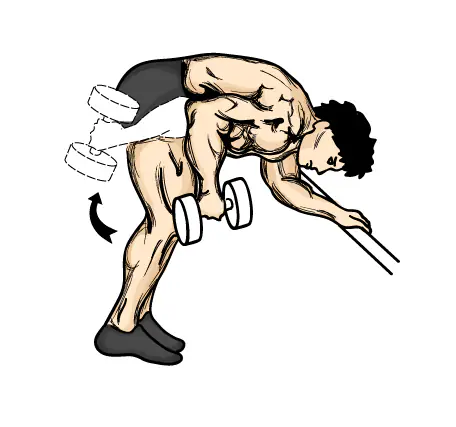
Why do your triceps matter so much?
Most people think of the biceps when they picture big arms. Yet the triceps make up almost 60% of your arm. They form the base of the upper arm and give it that full, eye-catching look from the side and from behind. If you want bigger arms, never skip your triceps exercises.
The triceps have three sections, or heads: the long head, the lateral head and the medial head. Together they straighten your elbow. Kickbacks train all three, and they are especially good at working the muscle hard in its fully shortened position, with the arm locked out straight. That is the point where you feel the strongest squeeze.
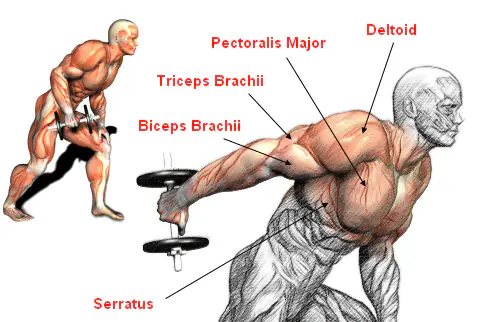
The labelled diagram below shows where the triceps brachii sits on the back of the upper arm, next to the shoulder and chest muscles.
When should you do kickbacks in your workout?
Kickbacks use light weights and work one arm at a time. That makes them a poor choice as your first, heaviest exercise, but a great one later in the session. Use them to hit your triceps after a heavy exercise such as lying barbell triceps extensions (often called skull crushers) or the close grip bench press.
They also work well at the very end of your triceps workout, when you are about to call it a day at the gym. A few strict sets give the muscles a final pump. Since the weight is light, they put little strain on your elbows even when the muscles are tired.
Dumbbell triceps kickbacks: correct form
Correct form is what makes this exercise work. It helps the muscle grow and makes sure the triceps, not your shoulder or back, do the work. Master the technique first, then think about moving on to heavier weights.
Getting into position
- Hold a light dumbbell in one hand. Place your other hand and the knee on the same side on a flat bench, as shown in the pictures and animation.
- Keep your back flat, roughly parallel to the floor.
- Raise the working arm so your upper arm is parallel to the ground and tucked close to your side. Bend it at the elbow so your forearm hangs down. This is the starting position.
The kickback
- Moving only your forearm and keeping your elbow fixed, breathe out gently as you kick the dumbbell back until your arm is straight and parallel to the ground.
- Hold for a second and squeeze the back of your arm.
- Breathe in as you lower the dumbbell back to the starting position.
- Check that the movement is correct. Only your forearm moves, never your elbow or upper arm.
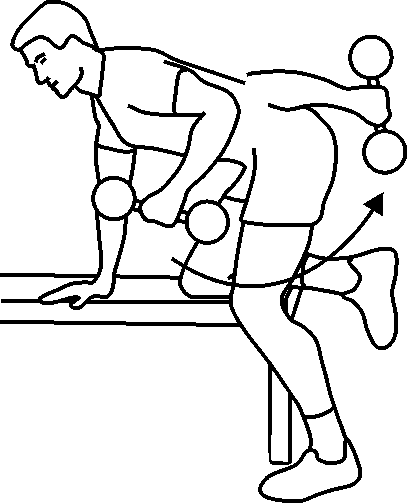
Each set should be done with a moderate weight and proper form. Finish all your reps on one arm, then switch to the other, the same way you would with concentration curls for the biceps.
Mistakes that stop kickbacks working
- Swinging the weight. Do not use body momentum to swing your arm. Use a lighter dumbbell and follow the correct form above.
- Dropping the elbow. If your upper arm sags towards the floor, the triceps lose tension at the top. Keep it level with your back throughout the set.
- Going too heavy. A dumbbell that is too heavy forces you to swing it. Most people use far less weight here than on other triceps exercises, and that is fine.
- Rushing the lowering. Let the dumbbell return slowly. Dropping it quickly wastes half of every rep.
- Rounding the back. Keep your spine flat and your head in line with it to protect your lower back.
It also helps to have a spotter hand you the dumbbell while you get yourself into the correct position on the bench. That way you can set up your back and supporting arm properly before you start.
The video below shows a strict set with a fixed elbow.
Kickback variations to try
Two-arm bent-over kickback
Stand with your knees slightly bent and lean forward from the hips, holding a dumbbell in each hand. Kick both arms back together. This saves time, but you need a strong, flat back to hold the position.
Cable kickback
Using a low cable pulley keeps steady tension on the triceps through the whole movement, including the bottom where a dumbbell feels very light. It pairs well with the triceps press down, which uses the same machine.
Resistance band kickback
If you train at home, loop a resistance band under your foot or around a low, sturdy fixed point. The band gets harder to stretch as your arm straightens, so the top squeeze feels especially strong. It is a handy option for travel or holidays, when you have no dumbbells to hand.
How many sets and reps?
A normal routine is 3 sets of 10 to 12 repetitions on each arm. Choose a weight that lets you hold the top position for a full second on every rep. If you cannot pause at the top, the dumbbell is too heavy.
To progress, add reps before you add weight. Once you can do 3 clean sets of 12, move up by the smallest dumbbell step your gym offers, often 1 to 2 kg (2 to 4 lb). Drop back to 10 reps with the new weight and build up again. Slowing the lowering phase to three seconds is another way to make the same dumbbell feel harder.
A simple triceps session could be the close grip bench press, then lying triceps extensions, then kickbacks to finish. Train triceps once or twice a week and leave a day or two between hard sessions. Look through our triceps exercises for more ideas.
More in Triceps Exercises
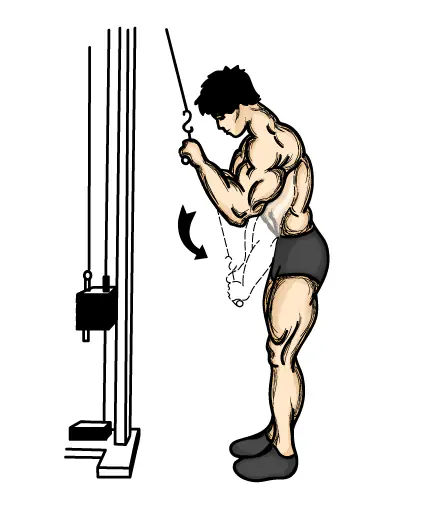
Triceps Press Down
The triceps press down, also called the triceps push down, is one of the most common exercises you will see in any gym. You stand at a cable machine, hold a short…
Read more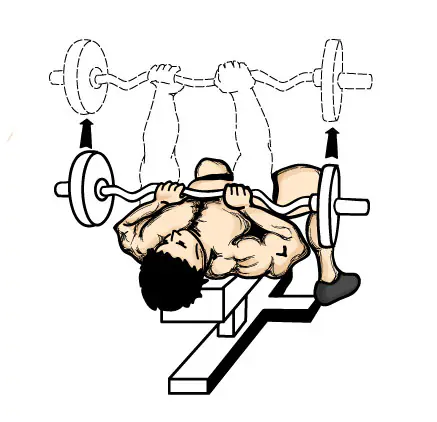
Close Grip Bench Press
The close grip bench press is a barbell press done with your hands closer together than in a normal bench press. That small change moves much of the work from your chest…
Read more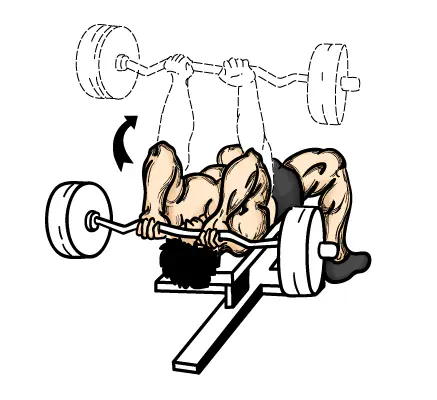
Lying Barbell Triceps Extensions
Lying barbell triceps extensions are an isolation exercise for the back of the upper arm. You lie on a flat bench, hold a barbell above your chest and bend only at the…
Read more